English
 Español
 Français
 China
China

What Is a Roll Die Cutting Machine and How Does It Work for Paper Cups?
If your cup forming line ever stalls because the blank supply can’t keep pace, you already know the pain point. Feeding pre-cut sheets into a flatbed press creates a bottleneck: stop, feed, cut, stack, repeat. That’s exactly why high-volume manufacturers switch to a Roll Die Cutting Machine. This equipment pulls a roll of PE-coated paperboard directly from the unwind stand and, in one seamless motion, cuts out the fan-shaped blanks, creases the fold lines, and strips away the waste web. No pausing, no manual sheet handling—just a continuous stream of finished blanks ready for the cup former. In this article, we’ll explain the rotary process, walk through each component, and show how an inline flexo printer can turn raw board into printed, cut, stacked blanks on a single machine.
The Core Idea: A Die That Never Stops Spinning
A flatbed die press pushes a flat die down onto a sheet, then lifts it. That’s reciprocating motion, and it’s inherently intermittent. A rotary die cutter wraps the die around a cylinder that spins continuously. The paper moves at a constant speed, and each rotation completes a full set of cuts.
For cup blanks, continuous motion means dramatically higher throughput. Typical rotary speeds range from 150 to 300 cuts per minute, compared to 30–120 for flatbed. That difference adds up fast when you’re running millions of cups per month.
The geometry of a cup blank—a curved fan with notches and a straight edge—suits rotary cutting perfectly. The die cylinder carries sharp rules for cutting and blunt rules for creasing, all arranged in repeating patterns across the cylinder face.
Why Rotation Wins for High Volume
Every time a flatbed press cycles, it spends a third of the cycle accelerating and decelerating the material. A rotary cutter doesn’t have that penalty. Once the web is up to speed, it never stops. That’s why you’ll see rotary die cutters on lines that run 24/7—they simply don’t waste motion.
Inside the Cutting Station — Three Critical Parts
Let’s look at the three main components that make this work. The rotary die cylinder is a steel cylinder with cutting rules and creasing rules mounted into precise grooves; the rules follow the exact shape of your cup blank, and as the cylinder rotates, they press against the paper. Below it sits the anvil roll, a smooth hardened steel surface that provides a backing for the rules; over time the anvil develops grooves along the cut lines, so better machines let you shift the anvil axially to expose fresh steel or include a regrinding schedule. Finally, the stripping unit—usually rotating brushes or fixed pins—separates the finished blanks from the waste web; if stripping fails and waste wraps around a roller, the entire line stops, so clean waste removal is non‑negotiable.
The Rotary Die Cylinder
The die cylinder carries two types of rules: cutting rules (sharp, ground to a specific height) and creasing rules (blunt, slightly lower). The die maker mounts these rules into grooves machined into the cylinder. The position of every rule is critical—a 0.1mm error in a cutting rule shifts the blank shape and affects how the cup will seal later.
The Anvil Roll
Smooth and hardened, the anvil provides a backing surface. Cutting rules go through the paper; creasing rules only indent. Over time, the anvil develops grooves along the cut lines. Some machines let you shift the anvil axially to expose fresh steel. Others require regrinding every few million cuts.
The Stripping Unit
After cutting, the web is a mix of blanks and waste paper. The stripper—rotating brushes or fixed pins—pushes the blanks out while the waste winds onto a separate shaft. Clean stripping is critical. One missed waste tail can wrap around a roller and stop the line.
From Roll to Stack — A Step‑by‑Step Walkthrough
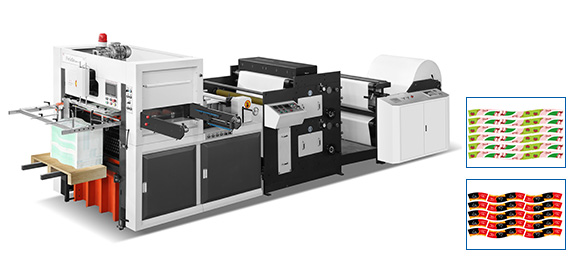
Here’s how a typical integrated line runs, using a machine like the Roll Die Cutting Machine inline Flexo Printer from Feida.
Unwind. A roll of cup board (up to 950mm wide, 1,600mm diameter) sits on a shaft with closed‑loop tension control. The machine pulls the web forward at a constant speed.
Printing (optional). Two to six flexo printing stations apply graphics directly onto the moving web. IR dryers cure the ink between stations, and registration marks are printed alongside the graphics.
Registration control. A photoelectric sensor reads the registration marks just before the die cutter. If the print position drifts, the control system adjusts either web tension or die cylinder phase to keep cuts perfectly aligned with the graphics.
Die cutting. The web passes between the rotary die cylinder and the anvil roll. Cutting rules sever the blank outline; creasing rules press the fold lines (bottom crease and side seam crease). All in one rotation.
Stripping. The waste web (the lattice of paper left after removing the blanks) peels upward away from the blanks. A stripping unit—rotating brushes or fixed pins—ensures the blanks drop cleanly while the waste winds onto a separate rewind shaft.
Stacking. Finished blanks fall onto a conveyor or a reciprocating stacking table. When the stack reaches a preset count, the table indexes down or a new stack begins automatically. No manual handling.
Why the Unwind Tension Matters
If tension is too low, the web sags and wanders sideways, causing misaligned cuts. If tension is too high, the paper stretches, changing the blank dimensions. Modern machines use load cells and servo‑driven nip rollers to maintain constant tension regardless of roll diameter.
Rotary vs. Flatbed — a Quick Comparison
Rotary die cutting runs continuously at 150–300 cuts per minute, feeds directly from a roll, allows easy in‑line printing, strips waste automatically, and has higher initial tooling cost but longer tooling life (millions of cuts). Flatbed cutting runs reciprocally at 30–120 cuts per minute, requires pre‑sheeted stacks, typically needs a separate printing step, often relies on manual or semi‑automatic waste stripping, and has lower initial tooling cost but shorter tooling life (hundreds of thousands of cuts). For standard cup board (250–400 gsm) at high volume, rotary is the standard because throughput and labor savings outweigh the higher die cost.
| Feature | Rotary Die Cutting | Flatbed Die Cutting |
|---|---|---|
| Motion | Continuous rotation | Reciprocating (up/down) |
| Speed | 150–300 cuts/min | 30–120 cuts/min |
| Feeding | Direct from roll | Pre‑sheeted stacks |
| In‑line printing | Easy | Separate operation |
| Waste stripping | Automatic | Often manual |
| Tooling cost (initial) | Higher | Lower |
| Tooling life | Millions of cuts | Hundreds of thousands |
Three Practical Checks Before You Buy
Experienced production managers look at three things before signing a purchase order.
Stripping reliability. Run the machine with your actual cup board, not just pristine virgin stock. Watch the waste web. Does it break? Does it leave small tails attached to the blanks? If stripping is unreliable, you’ll spend half your shift clearing jams. Ask to see a demo with recycled board or higher‑moisture stock.
Registration stability. Accelerate the machine from a stop to full speed, then slow it down. Does the cut position shift relative to the print? On a well‑tuned servo‑driven system, registration should stay within ±0.2mm regardless of speed changes. If it drifts, you’ll waste a lot of material during every speed adjustment.
Die change time. Ask the operator to swap the die cylinder while you time it. Quick‑lock hardware should allow a change in 15–20 minutes. If it takes 45 minutes and requires tools, you’ll lose hours every week when switching between cup sizes.
Why Stripping Deserves Extra Attention
Most downtime on older rotary cutters comes from waste wrap, not from cutting errors. If the stripper leaves even a small tag attached to the blank, that tag can catch on a roller and pull the whole web offline. Look for machines with servo‑driven stripping brushes and adjustable air jets—they handle a wider range of materials.
Speed, Materials, and Common Answers
Feida’s inline printer + cutter runs at 100–180 cuts per minute; at 120 cuts with a 6‑up layout (six blanks per cut), that yields 720 blanks per minute or about 43,000 per hour—ample for most small to medium cup plants. Paperboard from 120 to 400 gsm runs well; up to 600 gsm is possible but slower. PE‑coated cup stock is the most common, but recycled board works too (though it’s more abrasive, expect more frequent anvil maintenance). Do you need the inline printer? Not if you buy pre‑printed rolls, but if you print your own, inline printing saves handling and reduces registration waste; you can also disable the print stations and use the machine as a dedicated cutter. PLA‑coated board is stiffer and heat‑sensitive, so keep line speeds moderate and check stripping often—PLA waste doesn’t break as cleanly as PE.
Q: What’s the thinnest paper I can run? A: Around 120 gsm. Below that, the web flutters and registration suffers.
Q: Can I run the same die for different cup sizes? A: No. Each blank shape requires its own die cylinder. That’s why quick die change is so important.
Q: How often do I need to sharpen the cutting rules? A: Depending on material abrasiveness, every 1–3 million cuts. Some shops send dies out for sharpening every six months.
Why an Integrated Line Saves You More Than Floor Space
Separate printing and cutting means moving rolls between machines, storing semi‑finished goods, and managing two operator teams. Each transfer adds registration error. Each roll change adds waste at both ends.
An integrated line eliminates those handoffs entirely. The Feida unit keeps the web under tension from unwind to finished stack. The electronic registration system ties print and cut together, so misregistration is caught and corrected in real time, not after a whole roll is ruined.
For multi‑shift operations, the labor savings alone often justify the higher upfront cost compared to buying separate printer and cutter. Plus, you free up floor space that could be used for additional forming machines or storage.
Real‑World Savings from a Single Pass
One cup plant I visited switched from a flatbed cutter plus separate printer to an integrated rotary line. They cut labor by two operators per shift and reduced waste from 8% to 3%. The inline registration system meant they stopped throwing away rolls where the print drifted relative to the cut. That paid for the new machine in 14 months.
What to Do Next
You now have a clear picture: a Roll Die Cutting Machine removes the stop‑and‑start friction of sheet feeding, cuts and creases continuously, strips waste automatically, and when paired with an inline flexo printer, turns a roll of raw board into printed, cut, stacked blanks on one machine.
【Request a quote from Feida for the Roll Die Cutting Machine inline Flexo Printer 】— provide your cup sizes (ounces), monthly blank volume, paper weight range, and number of flexo colors needed. Their technical team will recommend web width, tooling, and stripping configuration for your specific line.